Insight
How to make your firm the answer in AI search
Why the next pitch you lose might be one you never knew was happening.
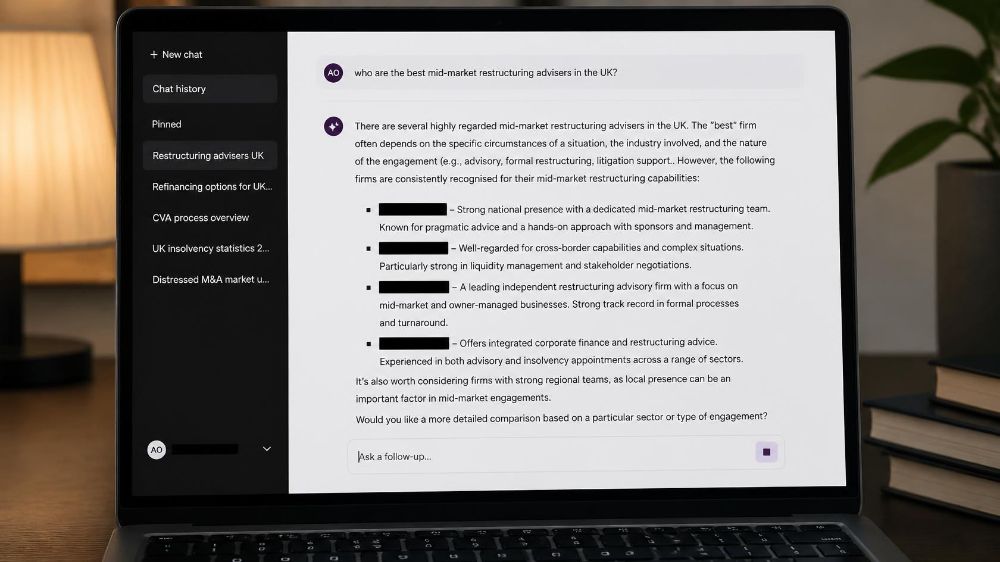
There's a meeting you're not in the room for. A general counsel, a CFO, a private equity associate types a question into an AI tool — "who's good at cross-border restructuring in the mid-market?" — and in four seconds, three firms get named. Yours might not be one of them. Nobody told you the pitch happened. You just didn't win it.
That's the uncomfortable truth professional-services marketing hasn't fully absorbed yet. AI search isn't a new traffic channel to bolt onto the existing SEO plan. It's a pre-meeting reputation layer — a place where buyers form a judgement about who's credible before your business development team ever gets a name in the diary. Google alone now puts AI Overviews past 2.5 billion monthly users and AI Mode past 1 billion. This isn't an edge case anymore. It's the front door, and most firms haven't noticed someone moved it.
Why professional services get hit hardest
Buying expertise is an act of faith. You can't test-drive a tax opinion or return a badly executed piece of litigation strategy. So buyers look for proxies — signals of competence, independence, judgement, sector fluency — and historically those signals came from a trusted referral, a conference stage, a well-placed quote in the trade press.
AI tools now do that filtering for the buyer, compressing years of reputation-building into three confident sentences. The problem isn't that AI might get it wrong. It's that AI will get it fluent — sounding authoritative whether or not it's accurate — and most buyers won't know to check.
What these tools are actually reading
Strip away the mystique and AI search is pattern-matching across two pools:
- What you say about yourself — services, sectors, named experts, case studies, FAQs — provided it's current, specific, and not written in the passive-aggressive vagueness of most "About Us" pages.
- What credible others say about you — press coverage, directories, associations, conference programmes, client evidence — provided the story is told the same way in every place it appears.
Consistency is the quiet kingmaker here. A firm that describes its restructuring practice five different ways across its website, LinkedIn, directory submissions and press bio isn't multi-dimensional. It's unreadable — to a machine and, frankly, to a client.
Stop optimising for search. Start operating a citation economy
Here's the reframe worth shaping an entire content strategy around: AI tools don't rank you. They cite you. That's a different discipline entirely. Ranking rewards keyword density and backlinks. Citation rewards evidence — the kind a machine can lift, attribute and repeat without embarrassing itself.
Every asset your firm publishes should pass one test: could an AI system quote this as proof of something specific, without editorialising? A generic capability statement fails. A named partner's sharp point of view on a live regulatory question, published with a date and a real client problem attached, passes. Treat your website less like a brochure and more like a source document a very literal-minded journalist is about to fact-check. Because, increasingly, one is.
The visibility audit, stripped to essentials
- Ask the questions your buyers actually ask — including the unflattering comparison ones ("Firm A vs Firm B for employment disputes").
- Check how you and your top three competitors currently answer them — via the tools themselves, not just search rankings.
- Rewrite expert bios around problems solved, not job titles. "Head of Restructuring" tells a machine nothing. "Led the restructuring of three mid-market retailers through Covid-era CVAs" tells it everything.
- Keep a steady drip of earned media and owned commentary — not a single splashy report, but a pipeline.
- Make your key pages boringly easy to parse: clear headings, named authors, dated content, evidence over adjectives.
- Give someone the job. This sits across PR, marketing, digital and BD — and without an owner, it belongs to no one.
What to actually measure
Forget clicks as the north star. Track:
- Share of voice in the coverage and conversations that matter to your sector.
- Accuracy of the story — are the right experts and specialisms being surfaced?
- The quality of inbound enquiries, not just their volume.
- Errors and outdated claims that need correcting at the source, because AI tools have long memories for stale information.
Two things nobody's telling you
First: the win isn't the click, it's the shortlist. In high-consideration services, a buyer gets a useful AI-generated answer, forms a quiet positive impression, and approaches you weeks later through a referral or a direct search — with no referral traffic to show for the AI moment that actually swayed them. If your analytics only reward last-click attribution, you'll systematically undervalue the work winning you business.
Second: you cannot, and should not, try to be the answer to everything. Broad visibility dilutes a sharply positioned firm into wallpaper. The better question is narrower and more courageous: for which two or three expensive, urgent, high-trust problems should your firm be the first call? A firm known cold for one thing beats a firm vaguely cited everywhere.
And a quieter warning worth sitting with: AI visibility has a way of exposing internal ambiguity that used to hide comfortably in inconsistent marketing. If your partners, your website, your pitch decks and your press coverage can't agree on what makes you different, an AI summary won't invent a convincing answer on your behalf. It will simply reproduce the muddle — confidently, and in front of exactly the people you were trying to impress.
Want your firm to be the answer, not a footnote? That starts with an honest audit of what the machines are already saying about you.